

GUIDE
Evolve Your Operating Model for the Agentic Future
THE AGENTIC OPERATING MODEL
Six Pillars That Decide Whether Your AI Program Scales or Stalls
Strategic Direction & Governance
Align agentic AI, AI & automation to the business vision with guardrails for scale.
Architecture & Security
Build a secure, flexible foundation that supports growth and trust.Talent & Velocity
Enable and sustain skilled teams to deliver faster, smarter outcomes.
Pipeline & Priority
Discover the right opportunities to maximize business impact and adoption.
Delivering Outcomes
Deliver solutions consistently, safely, and with measurable business impact.
Value Tracking & Insights
Transform data into proof of impact and actionable business intelligence.
INTRO
Every enterprise leader is under pressure to ship AI
Every enterprise leader we talk to is under pressure to ship AI. The board wants a demo. The CFO wants a number. The vendors want a contract. And somewhere on the seventh floor, a team that has been running robotic process automation (RPA) for six years is quietly bracing for impact.
They should be.
PILLAR 01
Strategic Direction & Governance
Align agentic AI, AI & automation to the business vision with guardrails for scale.
Strategic Direction and Governance ensures that funding decisions become defensible against a well-defined standard. Historically, that meant tying every Intelligent Automation initiative back to a business outcome, along with success criteria like cost savings, hours saved, revenue generated, better customer experiences, and more. Agentic AI initiatives are no different. If their outcomes cannot be defended, they will not be funded. Decide how your organization will measure its success and bake it into your funding model. What makes AI different is the scope of addressable opportunities is greater, meaning there’s more value available to capture if you get it right.TAKEAWAY
If their outcomes cannot be defended, they will not be funded.
PILLAR 02
Architecture & Security
Build a secure, flexible foundation that supports growth and trust.
RPA bots are not “set it and forget it”. They require a team to maintain them, fix brakes, and audit logs for compliance. AI agents are the same. They must be monitored, their decisions explainable and auditable. The underlying infrastructure must allow for this visibility. Without it, it’s a black box.
Agent-level visibility is only part of the picture. Agents rarely run a process from end to end. They sit alongside RPA bots, APIs, low-code apps, and humans, each doing what they do best. That mix surfaces three challenges we consistently face with agents: coordination (who hands off to whom, and when), standardization (each actor speaks its own language), and cohesion (the workflow only exists in pieces, never as a whole).
Addressing all three takes a business process orchestration layer that governs every actor under one design. A good example is UiPath's Maestro, built on the BPMN 2.0 standard. It coordinates agents, bots, APIs, and people in a shared process model, standardizes how each step is defined and measured, and holds the workflow together as a single governed unit. When an instance needs to be paused, retried, or rolled back to a previous step, the orchestration layer makes that action available to the user. Without this connective tissue, an enterprise ends up with a portfolio of agents that individually might meet audit standards but collectively cannot be governed as an end-to-end workflow.
It’s also important to adapt your organization’s risk framework, determining the level of scrutiny each AI agent will undergo before it ships. Not every agent carries the same weight. A meeting-note generator with no customer-facing output belongs on a different track than an agent that can write back to systems of record or influence a regulated decision. Ashling's Risk-based Tiering Model sorts agents into four levels based on what data they touch, what systems they can act on, and what decisions they influence. Tier 1 is a pre-approved pattern that ships in a week. Tier 4 goes to a full cross-functional governance committee before anything is built. The right tier for each use case is a governance decision, and getting it right up front is what keeps the committee from becoming the bottleneck.
TAKEAWAY
Determine the infrastructure, procedures, and risk framework your organization needs to achieve full visibility of your automated processes with guardrails for scale.
PILLAR 03
Talent & Velocity
Enable and sustain skilled teams to deliver faster, smarter outcomes.
The talent bench most enterprises built for IA CoEs cannot move at the speed agentic AI demands. It's work now calls for prompt engineering, ML, and data engineering, with fluency in LLMs, agentic platforms, and vibe coding, all grounded in real operational and industry depth. The Forward Deployed Engineer, the embedded engineer fluent in all of the above, is the aspirational profile. But the ideal FDE is a unicorn the talent market has not caught up to yet. The near-term answer is a Forward Deployment Team: a multidisciplinary squad that collectively covers the skill set while you train your existing people into the individual disciplines over time.
Velocity is where the second trap lives. AI teams can confuse motion for progress; where token consumption and infrastructure costs scale with utilization. Ship more agents faster without a cost measurement discipline, and you can grow velocity while shrinking ROI. Measure velocity honestly.
TAKEAWAY
Ship more agents faster without a cost measurement discipline, and you can grow velocity while shrinking ROI. Measure velocity honestly.
PILLAR 04
Pipeline & Priority
Discover the right opportunities to maximize business impact and adoption.
Every organization needs to decide how ideas become funded work. That means an intake process that filters what enters the pipeline and a prioritization framework that ranks what gets built first. In the RPA era, both were built to answer one question: should we automate this? The answer came from volume, frequency, data readiness, and business value. That question still matters, but it is no longer sufficient. A second question sits alongside it now: should we solution this with agentic AI? Ashling's evaluation framework runs every use case candidate through three gates in order. First, is there value, hard or experiential. Second, should it be automated. Third, should an agent do it, scored across logic, outcomes, human oversight, input adaptability, and integration complexity.
Clearing the gates does not mean building the work. It means the candidate has earned a spot in the stack, where it is ranked against every other candidate that made it through. Decide what your intake and prioritization discipline looks like before you start building, or the best opportunities will pass you by while you build the wrong ones.
TAKEAWAY
Decide what your intake and prioritization discipline looks like before you start building, or the best opportunities will pass you by while you build the wrong ones.
PILLAR 05
Delivering Outcomes
Deliver solutions consistently, safely, and with measurable business impact.
The delivery methodology most enterprises used to ship RPA cannot ship agents safely. Requirements gathering more often means defining a new process than documenting an existing one. Agentic solutions involve more human-in-the-loop checkpoints. And delivery teams depend on data owners and application owners the RPA team rarely had to coordinate with. Ashling's delivery methodology has evolved for this reality across all five phases: Analysis, Design, Build, UAT, and Deploy.
Requirements gathering now assume many processes are being defined for the first time, not just documented. Solution Architects join Analysis and UAT readouts to catch issues before Build. UAT scenarios are walked through during Analysis to pressure-test scope early. Business user guides are drafted during Design to expose gaps while there is still time to fix them. Production runbooks start during Build so handover to managed services is clean, not rushed. Every phase now ends with a stage gate the project leader owns, because the cost of a missed check compounds fast in agentic work. Decide what your delivery methodology looks like for agentic work now, before your first agent goes to production and exposes every handoff your RPA methodology never had to plan for.
TAKEAWAY
Decide what your delivery methodology looks like for agentic work now, before your first agent goes to production and exposes every handoff your RPA methodology never had to plan for.
PILLAR 06
Value Tracking & Insights
Transform data into proof of impact and actionable business intelligence.
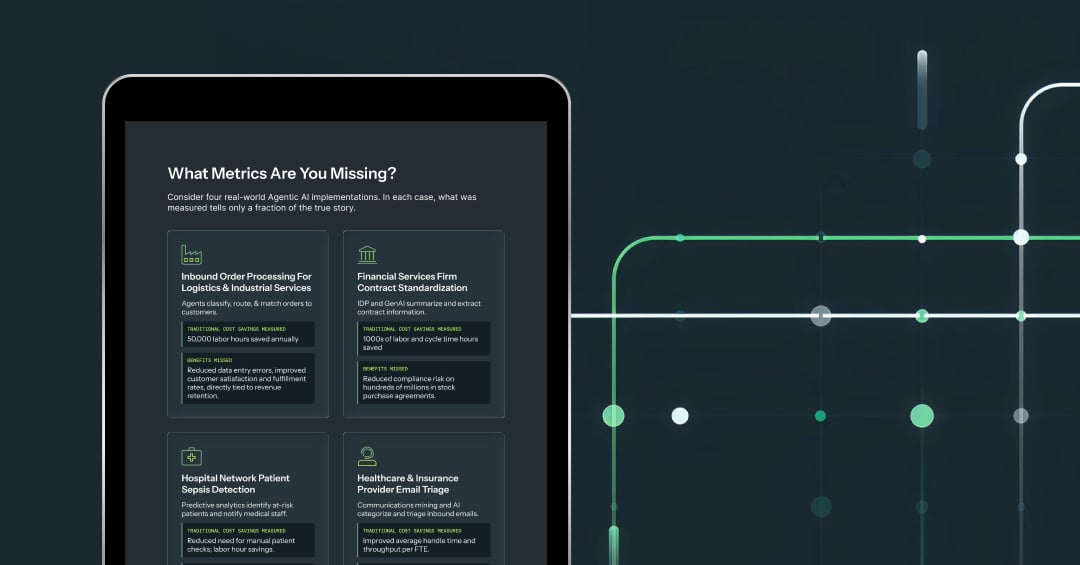
The measurement framework that enterprises inherited from RPA does not capture the full value of agentic AI. Labor hour savings still matter, but they capture a shrinking fraction of what agentic work delivers as it moves from RPA through AI to agentic AI. Measuring agents by hours saved alone is like measuring the value of the internet by how many phone calls it replaced. Ashling's measurement framework expands what counts as value across six dimensions: labor, quality, customer, revenue, compliance, and process visibility. Baseline each of them before an agent ships. Track target versus actual month over month. Report the numbers in language the board already uses; retained revenue, avoided compliance exposure, customer lifetime value, quality risk.
TAKEAWAY
Report the numbers in language the board already uses; retained revenue, avoided compliance exposure, customer lifetime value, quality risk.
THE BOTTOM LINE
Fold Agentic AI Into a Foundation You Already Have
The enterprises still shipping AI agents in 2028 will be the ones who treated agentic AI the way mature IA CoEs treated every technology before it: as something to fold into an existing operating model. The programs that survive will have evolved their operating model deliberately; on a foundation they already have.
Keep Reading
How Do I Prove the ROI?
The Ultimate Guide to Measuring Agentic AI Success
Demos & Videos
Why Agentic AI Needs Business Process Orchestration
.jpg)
.png?width=200&height=60&name=Ashling%20Logo%20(2).png "Ashling Logo (2)")